
Our Partners
Harnessing the ‘most powerful immune system of any land animal’
Seneca partners with ostrich farm for cosmetics, antibody applied research
Dec. 2, 2021
Forget celebrities and their high-priced moisturizers. A team of Seneca Cosmetic Science students has developed an all-natural face cream that may just hold the secret to softer and smoother skin.
And they have Yelena Anikeyeva and her ostriches to thank.
“If you touch my skin, you’ll see how crazy soft it is,” said Ms. Anikeyeva, founder and CEO of Ostrich Land and owner of its online store, Power of Ostrich, which is partnering with Seneca on a suite of applied research projects looking at the benefits of ostrich oil and ostrich egg white, yolk and shells.
Ms. Anikeyeva, her husband, Vladimir, and their son, Alexsey, are ostrich farmers in the Niagara Region. They initially teamed up with Seneca on a cosmetic science capstone project, for which the Seneca team developed a moisturizing face cream using ostrich oil and egg yolk.
“Ostriches have the most powerful immune system of any land animal,” Ms. Anikeyeva said. “For some people, ostrich oil works like a miracle. Look at me, I work outside every day, but my skin looks like I work in an office.”
Ms. Anikeyeva is now working with the Seneca Centre for Innovation in Life Sciences on two new projects.
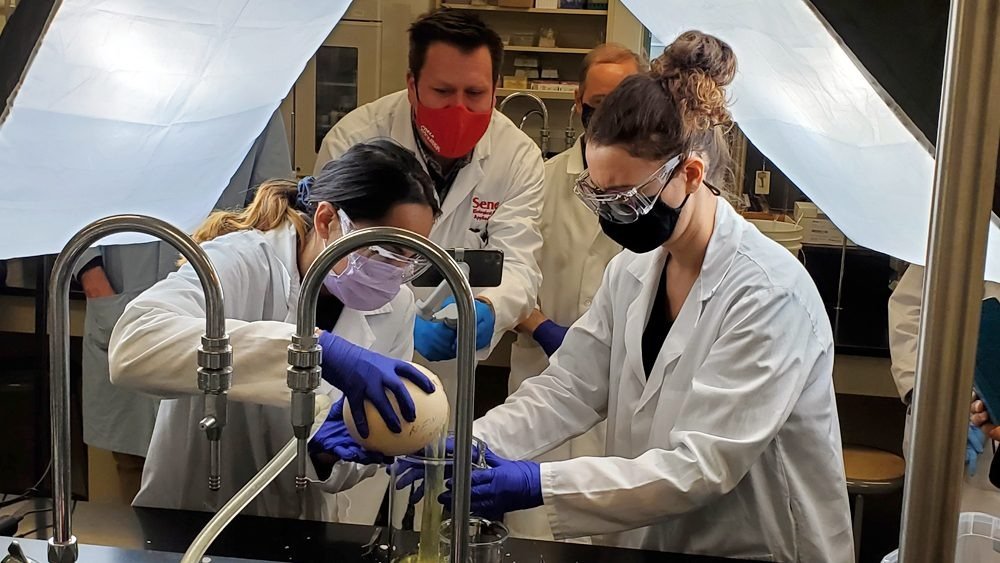
Hariti Gulati (left) and Amanda Miranda Savoini are student research assistants studying in the Biotechnology – Advanced diploma program. They work to remove the ostrich egg from the shell while Andrew Collop, a professor in the School of Biological Sciences & Applied Chemistry, watches. (Photo: submitted)
The first is to design and formulate an eczema cream infused with ostrich oil and yolk. It will be co-led by Sonal Kamath and Sharon Robertson, both professors in the School of Biological Sciences & Applied Chemistry. They will supervise a Cosmetic Science student, who will be a full-time research assistant on this project.
The resulting prototype cream will add to Power of Ostrich’s product line.
“With an ostrich egg, you get more fatty acids because it’s bigger than a chicken egg,” Ms. Robertson said. “You are putting all this concentrated stuff into a very thick yolk, which has a lot of antioxidants to help the skin to rejuvenate itself. It’s like you are double dipping and getting twice the amount of the good things.”
The second project with Power of Ostrich will investigate antibodies found in ostrich eggs and extracting them to potentially fight eczema, acne and other skin disorders. This project will be co-led by Dr. Frank Merante and Bryan Chalk and supported by two part-time student research assistants.
Dr. Merante, who previously worked on developing chicken antibodies as part of his PhD, says they will get about four to five grams of antibodies from each ostrich egg.
“This is desirable as an ostrich can lay up to 100 eggs a year in Africa and 50 in Canada, and they can live for 60 years in captivity,” he said. “The avian species are clever. They load up their yolk with antibodies, which then get transferred into the embryo. Everything the mother bird is immune to gets passed on the chicks.”
With the same theory in mind, the team has been monitoring an ostrich farm in British Columbia working on developing antibodies against COVID-19.
“If an ostrich is vaccinated against COVID-19 using a vaccine or similar protein, then the yolk from her eggs could theoretically contain antibodies against the virus or another pathogen of interest,” said Dr. Merante.
The goal for Seneca’s ostrich egg-related applied research is to develop a procedure that can be implemented for large-scale productions of antibodies for cosmetic and immunodiagnostic applications.
“Utilizing ostrich eggs as a resource could be really impactful across several disciplines, including cosmetics, diagnostics and therapeutics,” Dr. Merante said. “It’s fascinating.”
A bird’s-eye view into the skin-care industry
CHALLENGE
Ostrich Land Ontario, based in West Lincoln, raises 80 of the flightless birds. The farm offers tours in the warmer months and sells eggs, meat, feathers and its newest venture: Ostrich oil, for both humans and pets. Wanting to expand the commercialization of its Ostrich oil, the company partnered with Niagara College for some market research about expanding its product line.
SOLUTION
The Business & Commercialization team at the College undertook an extensive market and competitive analysis of the industry, searching trends in both the skincare and wellness industry. The team recommended to Ostrich Land that they pursue the flourishing field of cannabidiol (CBD)-enhanced beauty products line. Today, many skincare products, such as lotions, facial oils and lip balms, contain CBD. The research has saved the industry partner many months of time in evaluating the various options for commercialization
After launching their new ostrich oil product line under the Power of Ostrich brand, Niagara’s Ostrich Land Ontario, looked again to Niagara College’s Research & Innovation division to develop a digital marketing strategy. The Business & Commercialization team provided research on what social media platforms would provide the best ROI and developed a social media guide. As well, a website review was conducted and recommendations to streamline the site were provided. The industry partner recently launched a new product website: powerofostrich.com. Funding for the recent research was provided by The National Research Council of Canada’s Industrial Research Assistance Program (NSRC IRAP).
Niagara entrepreneur Yelena Anikeyeva has a long-standing fascination with the world’s largest bird – the ostrich. Their ancient roots, their power, and gracefulness all bolster her passion.
In 2016, she and her husband, Vladimir Panov, decided to sell their home and purchase a farm in West Lincoln to start raising ostriches. The farm – the only one in Ontario and one of only a handful in Canada – now boasts 80 of the flightless birds.
As the CEO of Ostrich Land Ontario, it is mainly Anikeyeva at the helm, caring for her flock, conducting tours in the warmer months, selling eggs, meat, feathers and her newest venture: Ostrich oil, in its many forms, for both humans and pets.
Wanting to dive deeper into the commercialization of her ostrich oil, Anikeyeva looked to the Business & Commercialization team at Niagara College after hearing about the College’s research capabilities at a business-to-business event.
“I had some ideas about byproducts with ostrich oil and wanted to do specific research into both the beauty and the wellness marketplaces.”
Anikeyeva points to the unique benefits that are derived from ostrich oil, given that it is packed with Omegas 3, 6 and 9 fatty acids, all important to our health and beneficial for skin issues, such as wound healing, she says. Through her website and specialty outlets, she sells moisturizers, balms and massage oils.
“It has a long history; more than 3,000 years ago, Cleopatra and the Egyptians used ostrich oil as part of their beauty regime.”
As I researched, I learned that CBD is being incorporated into skincare and has become a trend in the beauty industry,” says Lopez, a student with NC’s Bachelor of Business Administration (International Commerce and Global Development) program. “Furthermore, CBD used in skincare products is derived from the hemp plant and has no psychoactive properties.”
Today, many skincare products, such as lotions, facial oils and lip balms, contain CBD, explains Lopez.
While her current recommendation is for Ostrich Land to focus on the CBD-infused beauty products, Lopez did also research the health and wellness trends for CBD, where she found a thriving industry, most notably for pain relief and anti-inflammatory benefits.
Anikeyeva credits the Research & Innovation team for saving her valuable time spent doing research herself.
“It’s very important because I could spend a half a year to do this research on my own and I’m not able to do it right now, so it was very, very helpful.”
Meanwhile, she’s also eager to seek out more research for replacing MCT oil (a common carrier used in CBD oil on the market) with ostrich oil. Cannabinoids are fat-soluble, so taken with an easily-metabolized fat purportedly increases its bioavailability.
Anikeyeva considers ostrich oil a better carrier than MCT oil because it may penetrate the skin deeper, due to its molecular structure, she posits.
In looking to expand her product line, it was the flourishing field of cannabidiol (CBD)-enhanced beauty products that Anikeyeva was interested in learning more about.
I need to prove and show, scientifically, that the combination of CBD and ostrich oil will give a greater result than combining with MCT oil,” she says, adding she would then be able to tap into the burgeoning CBD oil market.
As a footnote to her unwavering admiration with the ostrich species, Anikeyeva is also enthusiastic about the powerful immune systems of these venerable birds and is eager to learn more in this area. She’s not the only one.
Japanese scientists are studying the ostrich’s unique immune system, especially in antibody technology, hoping for breakthroughs to help humans reduce serious health issues. Researchers are looking at the higher quality antibodies produced naturally in ostrich and that can be extracted from the eggs.
Given their long history – fossil remains suggest the ostrich may have existed for millions of years – some experts believe this evolutionary process has led to their robust immune system. While native to the hot and dry savannas of Africa, ostriches have now evolved to survive the harsh conditions in most locations around the world.
At her farm, Anikeyeva says one ostrich can lay 50 eggs per season. That’s significant given that they also lay the largest eggs of any bird alive – a single egg is equivalent to two dozen chicken (hen) eggs.
The Business & Commercialization team offers a full suite of solutions to assist industry partners. To learn about other success stories, visit the website.
A bird’s-eye view into the skin-care industry was last modified: June 24th, 2020 by cms007ad